|
| |
| |
|
 |
|
Ealing Broadway station entrance
|
|
Ealing Broadway station has been a significant element
in the growth of the town centre since it opened 170 years ago.
The coming of Crossrail will mark a further point in its development,
which could have as great an impact on Ealing as any of the other stages in its history.
SEC's Vision statement identified several problems:
- The station is a terminus for two underground lines, and a stop for up to eight trains per hour
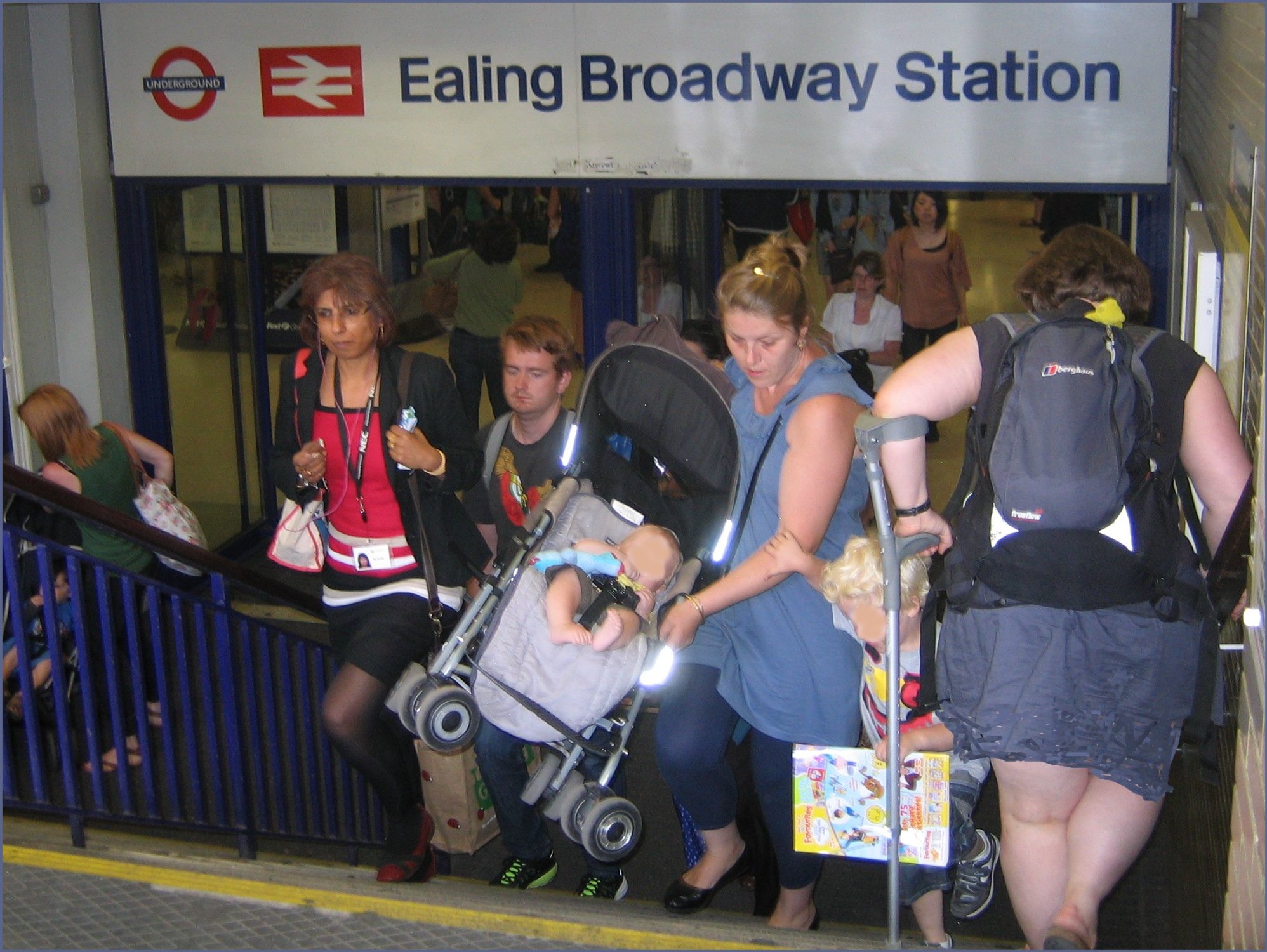
on the Paddington line. Entrance and exit to the station are overcrowded and dangerous at peak times,
with no step-free access to platforms or booking hall from street level.
- The only drop-off and pick-up facility for passengers from Ealing Broadway
station is inadequate.
- The taxi rank outside Ealing Broadway station can't be reached without crossing one or two roads.
- There are no legal pick-up and drop-off points for mini-cabs.
- The bus stops are not concentrated at the station and are spread out over Haven Green,
The Broadway and The Mall. There is no bus station even though it is a terminus for nine routes that run daily.
The station will need to be significantly modified to meet the needs of Crossrail,
due to start service in the central London section in December 2018. Our expectation
is that the work will be carried out before a "Crossrail" service from Paddington to Heathrow opens in May 2018.
Crossrail have subcontracted the detailed design work on the station to Network Rail.
They have in turn let a design contract to AECOM. This design stage is expected to take about a year to complete.
Crossrail are only concerned with changes to the station itself and have no powers
to embark upon a comprehensive redevelopment scheme for the area around the station.
The current outline design for the station is seriously disappointing in a number of respects:-
- Crossrail budget cuts have
meant that the changes have been kept to the bare minimum and do not
provide the sort of facilities for which Ealing has waited for many
years. There will be no escalators to the platforms and the ticket hall
will just be a refurbished shop on the station forecourt, rather than a
gateway to Ealing appropriate for a huge number of passengers.
- The station is expected to see an increase in passenger numbers
of over 40% over the next 15 years, yet there are no clear plans to
expand the pavements and bus facilities to cope with this growth.
- Integration of the station with bus stops and pick up / set down points remains as elusive as ever.
- No start is being made on a comprehensive redevelopment of the area around the station.
|
|
Let's Fix Ealing Broadway station!
SAVE EALING'S CENTRE PETITION LATEST
The public has overwhelmingly supported SEC's call to Ealing Council to
get a move on and improve Ealing Broadway Station. More than 1500
people have signed our petition to the Council and more are signing all
the time.
Richard Chilton from SEC formally presented the petition to the Council
at its full meeting in the Town Hall on Tuesday, 18th October. This was
followed by a debate in which several councillors supported our
position.
Background
SEC launched its petition asking the Council to fix Ealing Broadway
station in June 2011. Well over 1500 people have now signed the
petition either on line or on paper. This was enough to for us to seek
a Council debate on the matter.
We think that Ealing Broadway - West London's busiest transport hub and gateway to the Town Centre - is a disgrace.
The entrance is too small and even dangerous
There is no step-free access to either the booking hall or the platforms
The forecourt is cluttered, with no proper set down space
Outside, pedestrians have to cross a main road or push along narrow pavements
Bus stops serving the station are badly organised, congested or too far away.
Constant requests for improvement have been ignored. Too many different
organisations - including Network Rail, First Great Western, London
Underground, TfL, London Buses, and Ealing Council - are involved, so
nobody accepts responsibility for action.
Improvements promised through rebuilding the station for Crossrail are
now under threat. Cost cutting has reduced these to almost nothing, and
the completion date has been pushed back. Crossrail is close to
finalising the plans for the station which are likely only to be
concerned with increasing its capacity to handle extra passengers.
The opportunities to improve the station so that it becomes a real
asset in revitalising the centre of Ealing are not being pursued.
19 October 2011
|